 Happening today
 For travellers
 Business Pärnu
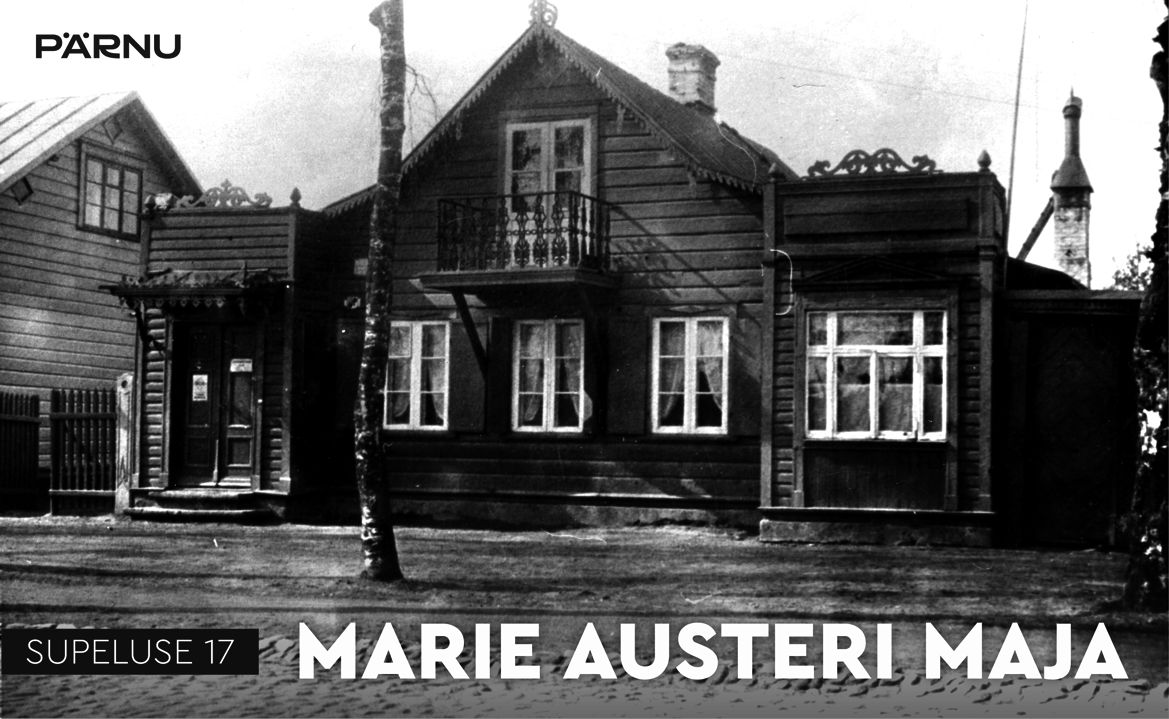
According to the Building Register, the house was built in 1845, but unfortunately, the builder and the first owner are unknown. The building was originally a traditional sloboda-type dwelling, which was extended with wings in the late 19th century.
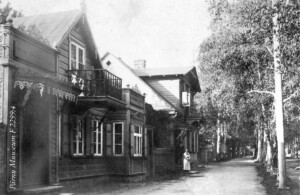 In 1889, the house was up for sale, offered by the heirs of Carl Wilhelm Fröhlich (1833-1883), a logging manager who had died a few years earlier. The new owner was Marie Helene Auster (1833-1921), the widow of Suure-Kõpu churchwarden from Viljandi County, who had moved to Pärnu a few years earlier.
The Auster family
Although the Auster family identified themselves as Germans in Pärnu, they had in fact a completely Estonian background − their ancestor Paap Auster (1781-1845) was a farmer in Mooste (Moisekatsi) near Põlva, who, as the schoolmaster of the Kauksi village school, tried to give his sons a better education as well. Thus, one of his sons, Samuel Auster, became a churchwarden-schoolteacher in Rannu, and the other son, Peter Julius Auster (1820-1881), became a churchwarden and schoolteacher in Suure-Kõpu Parish in Viljandi County. There, Peter Julius married Marie, a local peasant girl, and they raised eight children. The churchwarden, who had served the congregation for almost 40 years, died in 1881 and a memorial plaque was placed on the church wall, which remains there to this day.
After the death of her husband, Marie Auster moved from Viljandi to Pärnu, probably to live with her eldest son, Ernst Herman Johannes Auster (1857-1924), who was already working as a merchant in Pärnu. In his spare time, he sang in a local male quartet that was named the Pärnu Imperial Quartet after a performance in the summer of 1880 for the heir to the throne, Grand Duke Alexander (or later Alexander III), while he was hosted by Chamberlain Stael von Holstein at Uulu Castle.
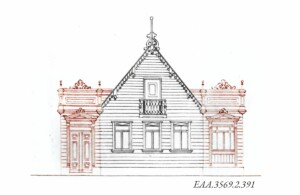
In 1889, Marie Auster acquired this house on Supeluse Street and a few years later commissioned a project to make additions to the house, adding a room on one side and a new entrance with a porch on the seaward side. They may have intended to rent out a few rooms to holidaymakers; at the same time, Alma Wilhelmine Mathilde Auster (1852-1925), Marie’s eldest daughter, who had become a tutor, came to Estonia from Russia. She started earning her living by giving French lessons and opened a lending library in 1905 in her house on Supeluse Street.
Auster Brothers’ cork factory
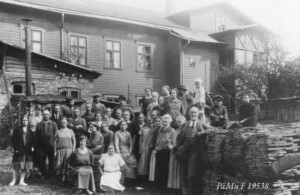 Marie’s second son, Hugo Paul Samuel Auster (1859-1935), started a small cork factory in 1888. The product, cut from the bark of cork trees, was primarily used by Pärnu breweries for corking bottles. The business was a success and soon had to be expanded. Hugo Paul involved his older brother Ernst in the business and the company was renamed the Auster Brothers’ Factory (Korkenfabrik “Gebrüder Auster”). The family acquired many properties around the intersection of Roosi and Pärna streets, where a larger industrial building was built that still stands today (Roosi 3). Originally one storey tall, a second floor was later built onto it.
Before World War I, the cork factory employed around 200 people and its products were marketed throughout Russia. In 1904, the cork factory started to use electricity to run its machines. Electric light was provided to the surrounding residential houses and the building of the Pärnu Bathing Institution received electricity as well.
The older brother Ernst died in 1924, but the company continued, making all kinds of corks from cork bark for bottles and barrels, fishing caps, lifebuoys, net floats, cork soles and heels for bootmaking industries, etc. When the company’s founder Hugo Auster died at the end of 1935, the company was taken over by his eldest daughter Elisabeth von Wahl (1900-1981). Before World War II, production was expanded into the building of the former distillery, which today houses the library of Pärnu College of the University of Tartu.
House on Supeluse Street
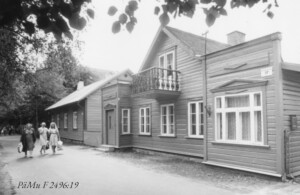
Although the mother Marie Auster died in 1921, the small house on Supeluse Street was still owned by the family, officially belonging to her granddaughter Elisabeth von Wahl. It was not until 1939 that the decision was made to sell the house and it was bought by Jaakob Karu (1885-1961) from Karksi Parish. The former owners left in the same year, resettling in Germany.
The house on Supeluse Street was small enough not to be taken from Jaakob Karu by the Soviet authorities. After his death in early 1961, the house was inherited by his two sisters, and later changed hands several times.