 Happening today
 For travellers
 Business Pärnu
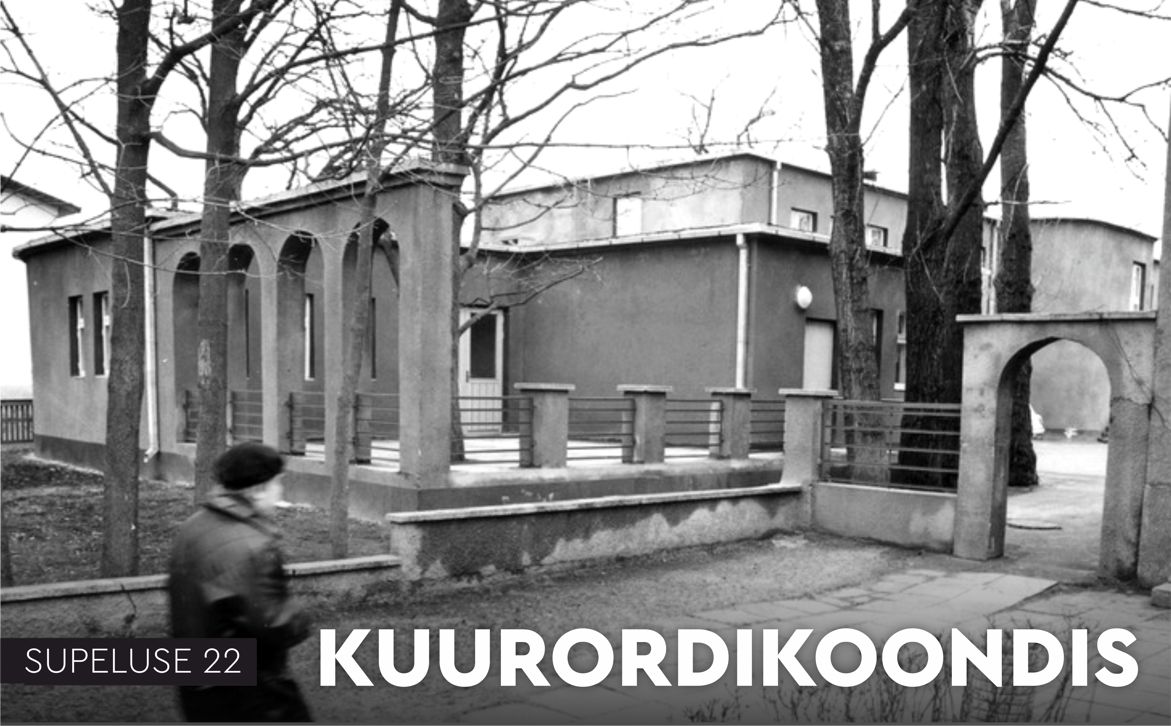
In 1985, a plot was allocated for the construction of an office building for the Resort Group. It was completed in 1987 and has now been completely rebuilt.
The Resort Group’s office building
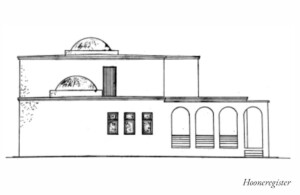
There was no permanent building on this site before. There was only the silicate auxiliary building of the sanatorium block, now located at Supeluse 24, at the back of the plot. Its walls were used when an administrative building for the newly formed Pärnu Resort Group was constructed.
The combined institution was formed at the beginning of 1974, when three Pärnu sanatoriums – “Estonia”, “Rahu” and “Sõprus” – that had previously operated independently were merged with the Mud Baths and the Resort Club (beach salon or resort hall) as supporting units. The aim was to bring them under a single management to increase productivity – by establishing a common warehouse management, consolidating the vehicle fleet and unifying supply systems. The official name was the Pärnu Resort Medical and Recreation Facilities Group.
As the central management needed central office space, the search for the most suitable location for an administrative building in the heart of the resort zone began in the new decade. A property on Nõukogude Street, which was already on the balance sheet of the Resort Group, was chosen. Since the main part of the construction work was done by the group’s own construction brigade, the two-storey building was completed quite quickly. It was opened in 1987 and the completed building had 18b Nõukogude Street as its address.
The main body of the building contained office space. A café with a large dome-shaped skylight was located in the part of the building on Supeluse Street. A hall with a similar dome-shaped skylight was built on the second floor. The architectural elements of the specially designed building blended harmoniously with the old building next door.
After the restoration of independence, a popular 24-hour alcohol shop opened in the café’s premises in the 1990s. The resort’s management continued in the wing in the courtyard, where the administration of the “Estonia” sanatorium was also located. Then the Trade Union Confederation, which became the owner of the building, decided to sell it to private ownership in early 2000. The new owner renovated the building and opened a guest house “Villa Delfine” with 20 rooms here.
Guest house Delfine and its third floor
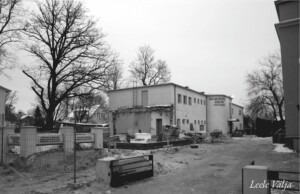 This guest house came into the media spotlight in 2008, as the city government undertook a process that was unprecedented in Estonia. Namely, an extension built by the entrepreneur without a proper building permit was going to be demolished despite the owner’s opposition.
The reason was the building’s recent expansion, when the part of the building on Supeluse Street was rebuilt in 2006, now as a three-storey building. Although this construction activity had the necessary approvals, the developer had also constructed an additional floor on the preserved courtyard wing. There was no building permit for this, and the additional floor was built despite injunctions and fines from the city government and opposition from neighbouring property owners.
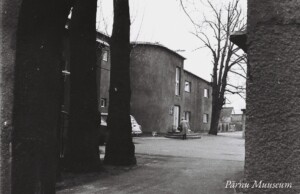 Since the hotel’s owner, who had changed in the meantime, refused to demolish the illegally constructed floor themselves, and the initial legal protection was revoked in the next court instance, the city government decided to begin enforcement proceedings through forced demolition. The saga culminated on 21 April 2008, when Mayor Mart Viisitamm personally visited the site. The demolition took six weeks, and the owner of the hotel was charged for the cost of the works as well as the legal costs, which totalled at more than a million kroons.
Today, the disputed third floor has been rebuilt based on the detailed plan adopted by the following city government in 2015. Instead of a guest house, private nursing homes were established in 2010 in both houses on Supeluse Street 22 and 24 – the Villa Mare boarding house and the Fööniks nursing home.