 Happening today
 For travellers
 Business Pärnu

Villa Doris is the most striking example of Heimatstil in Pärnu. It is a four-storey house with a high mansard roof with numerous slopes and corners. But this was not the first house on this plot…
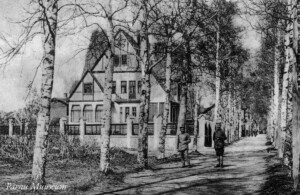 The earliest known owner of the property and the small wooden house on it was Juhan Peetson (1826-1891), who came from Enge Parish, Pärnu. Edmund Schwartz, a merchant of the I Guild in St Petersburg, bought the old house from Peetson’s heirs in 1912. He had the old house demolished and commissioned Erich von Wolffeldt, the son of Hugo von Wolffeldt, the long-time city architect of Pärnu, to design the new one.
Shipowner Markson’s villa
Schwartz, who had moved to Berlin after World War I, sold the house to the wealthy Kabli shipowner Markson in early 1921. Jakob Markson (1840-1930) was born in Mõisaküla, Enge Parish, as the son of a farmer, far from the sea. After learning carpentry from his father, he started building windmills in Pärnu County. While building a mill near Orajõe, he got a job at the shipbuilding company of Mats Grant, a shipowner and shipbuilder there, and married Dora, his daughter, in 1874. Then Markson himself went to sea, first as a self-taught captain on his father-in-law’s sailboat “Markus”. Having earned enough capital from his sea voyages, he began building his own ships, hiring captains for the ships and trading mainly in firewood (transporting it to Riga, St. Petersburg and elsewhere).
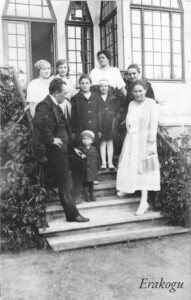 While Jakob Markson himself stayed in Kabli, he gave the house on Supeluse Street to his sons, August and Alexander, in 1927. His son Aleksander Markson (1884-1942) graduated from the University of Nancy in France in 1909 as a qualified electrical engineer, and he did not come to live in Pärnu. In 1917, he became the director of the Tallinn City Power Station, a position he held until 1941. However, Jakob’s second son, August Markson (1891-1948), Pärnu industrialist and public figure, moved into the villa on Supeluse Street.
August Markson had studied law at the University of Tartu, but dropped out. In 1919, he was appointed first as the chief of the Pärnu County militia, then as a court investigator. Soon, he moved into business, becoming one of the founders and the manager of the First Pärnu County Shipbuilding Association. The association started its activities on 26 July 1920 on the premises of the former Niidu Tavern and Brewery, which had burnt down during the war. In Pärnu, Markson became the Romanian consul in 1930 and the Belgian consul in 1932, but as an entrepreneur, he ran into difficulties, and his house on Supeluse Street was auctioned in 1935.
Villa Doris was first bought at auction by the Kroeber couple, who had rented an apartment in the same house. They then resold it to Aleksander Veiler in April 1936.
Estonia’s “newspaper king” Aleksander Veiler
The Veiler family had been spending their summers in Pärnu for years and had been looking for a summer home. The spacious villa, which would now be called “Villa Tooma“, was registered in the name of the wife, Stella Veiler. Part of the living space was kept as a summer apartment, while the second-floor apartment and the third-floor rental rooms were rented out.
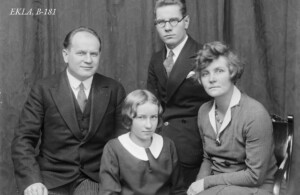 Aleksander Gustav Veiler (1887-1950) was one of the founders of the Tallinna Teataja newspaper in 1910 and its editor (1909-1914). He was the editor of the daily newspaper Päevaleht (1914-1917) and the founder of the newspaper Vaba Maa in 1918, together with Juhan Lui and Konstantin Konik, as well as the business manager and major owner of the printing industry and the publishing company Vaba Maa until 1940. His wife, Stella Viarda Veiler, who was from the Rakvere area, was a leading figure in the Estonian women’s movement. She was the co-founder of the Tallinn Women’s Society with her sister-in-law Johanna Päts, as well as a member of the board of the Estonian Women’s Union and chairwoman of the Tallinn Housewives’ Association. The Veilers were involved in the events of the declaration of the independence of the Republic of Estonia, organising its printing in Tallinn.
Nationalisation
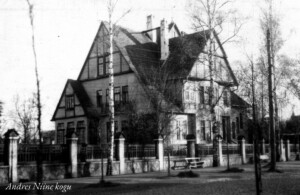
On 26 July 1940, Veiler’s printing house “Vaba Maa” was expropriated from him and renamed “Punane Täht”. Veiler managed to sell the house on Supeluse Street in Pärnu to the communist printing house as a holiday home for its trade union. In 1944, the Veiler family emigrated via Finland to Sweden, and from there to Canada in 1948.
In March 1941, the villa on Supeluse Street was transferred to the Sanatorium Fund of the Central Council of Trade Unions of the Estonian SSR, and the premises were acquired by the Specialised Sanatorium No. 2-4 of the Pärnu Resort. In later years, this building was known as building No. 3 of the sanatorium “Rahu”.
In 1993, the house was returned to Veiler’s descendants and has changed hands several times since. In 2008, Cardo Remmel, the former head of the Saku Brewery and later chairman of Pärnu City Council, opened an Italian restaurant Si-Si on the first floor together with his wife Kaja. The chef, who was invited from Italy, was tasked with educating the tastes of Pärnu residents and summer visitors − Italian cuisine is not just about pizza.
The restaurant operated until 2012, and today the building is used only as residential premises.