 Happening today
 For travellers
 Business Pärnu
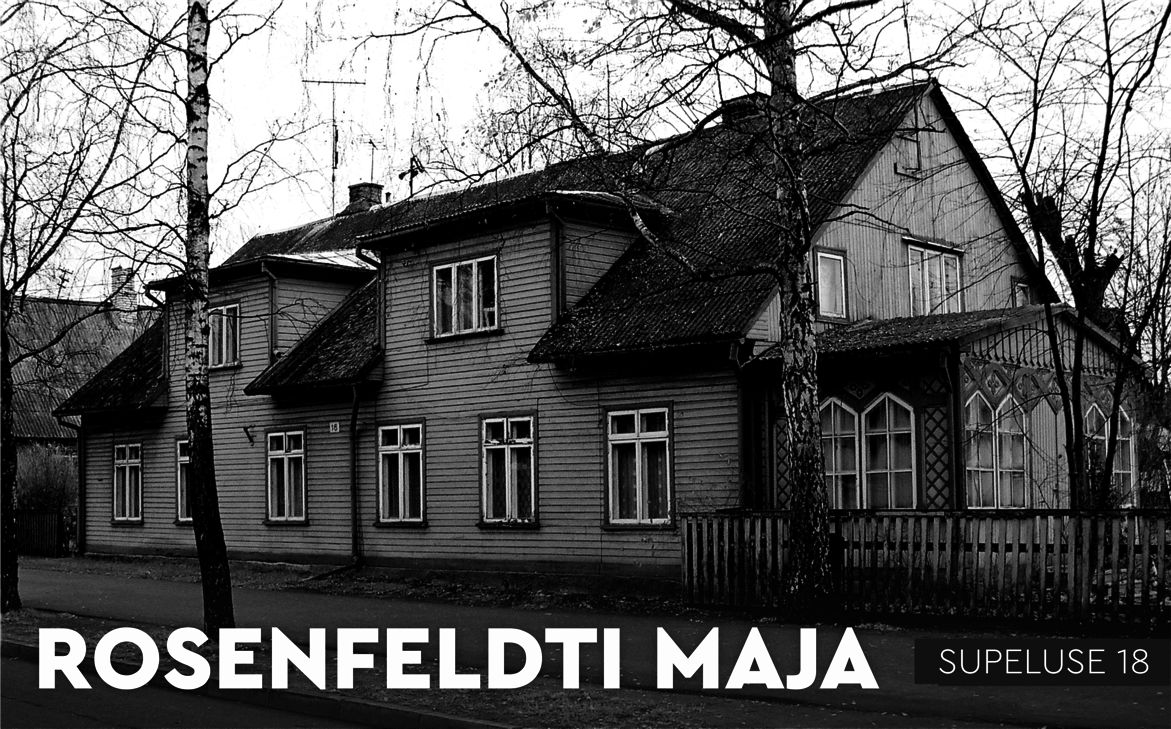
The earliest known owner of the large plot of land, originally stretching across the entire block between Auli and Roosi streets, was Dorothea Lampe, who put the property consisting of a dwelling house, stable, cattle shed and barn up for sale in 1824. In later years, the large property was split into smaller plots.
 The house at Supeluse 18, believed to have been built in the mid-19th century, stayed in the Rosenfeld family for a while. It was bought in 1885 by the father, Jakob Rosenfeld, a Jew born in Miitav (Jelgava) who earned a living as a hatter, a typical occupation for Jewish people at the time. He bequeathed his property to his daughters Olga and Ekaterina. Shortly before World War II, Jakob’s daughter Olga Rosenfeld (1869-1948) lived in one of the three apartments in the house, making a living by renting out the rest of the house, mainly as residential space, but occasionally also to the owners of various diners or hair salons.
In one of the apartments lived Anna Edelberg (Est. Elmest), an old lady who sublet space to the children who had come from the country to study in the city. In 1938-41, Endel Redlich, a pupil at Pärnu Boys’ Gymnasium, who would become the leader of the Estonian Forest Brothers and the founder of the Armed Combat Union, also lived in her apartment.
Leader in armed combat
 Endel Redlich (1923-1949), who had come to Pärnu from Vigala Parish in Lääne County, graduated from secondary school in 1941 and wanted to continue his studies at Tallinn Teachers’ Seminary, but instead had to hide from being mobilised to the Red Army. After the war and with the arrival of the new Soviet occupation, he became a Forest Brother again and set up a military resistance organisation.
The Armed Combat Union (RVL) was formed in early 1946 in the border area of Pärnu and Lääne County and united men capable of fighting whose goal was to oppose the violence of the occupying power. The statutes of the organisation, which had a solid structure and was led by a central staff, were drawn up by Redlich, who was only 23 years old at the time.
By the end of 1947, the Union had established county organisations in Harju, Järva, Tartu and Võru counties, as well as departments in Tallinn and Tartu. Ants Kaljurand (Hirmus Ants, or Scary Ants in English) joined the organisation, which had grown to almost 500 members. Redlich, who had received a bullet wound in his hand while requisitioning a car and had started wearing a black leather glove to hide it, began using the alias Must Kinnas (Black Glove). The NKVD, having gathered information as a result of the arrests, began to forcefully liquidate the organisation, and one of the last RVL leaders to fall was Endel Redlich, who was captured in April 1949 at Topi Farm in Kullamaa and shot dead while trying to escape.
Nationalisation
Olga Rosenfeld, the spinster owner of the house, died in 1948 and the house was taken over by the state. With the major renovation in 1953, the number of apartments in the building increased to five, and in the absence of legal owners, they have now been privatised. The former stable in the yard with a coachman’s apartment, which became a courtyard house with two apartments during the 1953 renovation, was rebuilt into a private house in 1999 based on a design by architect Maie Kais (now with a separate address at Supeluse 16).