 Happening today
 For travellers
 Business Pärnu
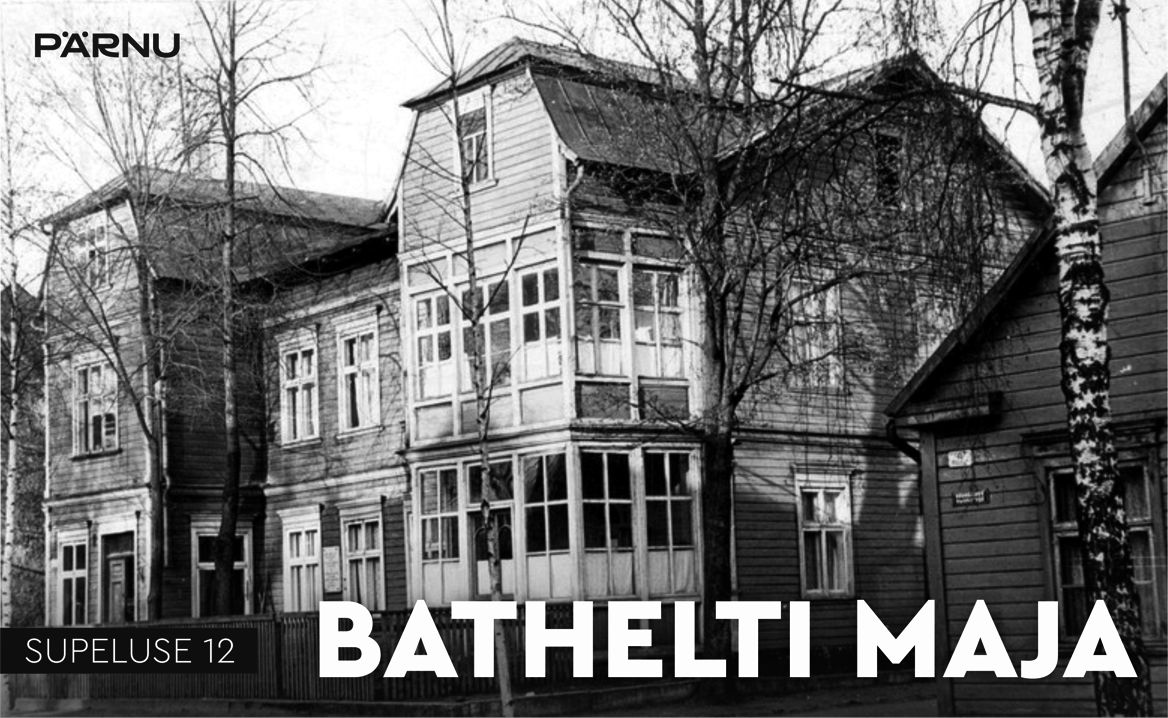
The earliest known owner of the property and the small house on it was Pärnu forester Gustaw Thomson (1811-?). His son, Gustaw Adolf Thomson (1857-1913), studied theology at the University of Tartu and in 1888 became a teacher in the Volga-German settlement in Saratov. Oscar Bathelt bought the house and the plot of land in Baade Street from him.
Confectioner Oscar Bathelt
Austrian Oskar Viktor Rudolf Bathelt (1853 – 1916) was born in Bielitz (Bielsko in Poland) and started a confectionery business on Rüütli Street in 1880. He was married to Marie Awik, from Kuressaare, who, as an enterprising woman, ran a haberdashery shop at Rüütli 32 and from 1894, she ran it in her own house at Rüütli 26. She sold umbrellas, socks, gloves and men’s neckties, walking sticks and hats. In addition, she offered bathing suits and beach parasols for the holidaymakers and also published postcards with views of Pärnu.
Provost Gustav Adolf Thomson, born in Audru
The Bathelt family bought a plot of land on Supeluse Street in 1890 and immediately commissioned a construction project for a magnificent villa with an attic floor. For some reason, the project was abandoned and instead, a rental house with two full floors and several apartments was built. The family stayed in Mrs Bathelt’s house on Rüütli Street and the apartments in the new house were rented out.
Façade drawing of the unbuilt house from the 1890 project
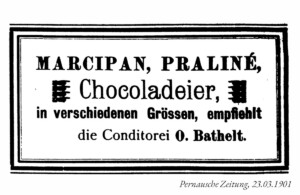
Advertisement for the confectioner Bathelt in the Pernausche Zeitung, 23 March 1901
Oscar Bathelt closed down his confectionery business in 1908 and handed the business, which he had been running in one location for 28 years, to Otto Philip Hufer. Hufer, a Bavarian, successfully continued the chocolate and confectionery business while also opening a café (in the Soviet period it was known as the Kungla Café).
On 14 January 1916, 62-year-old Oscar Bathelt decided to commit suicide and hanged himself in his home. The rental house on Supeluse Street was inherited by his widow, Marie, and their sons, Egon-Richard (born 1888), Alfred-Viktor (1890), and Ervin-Oskar (1891).
Why the street was named Nõukogude (“Soviet”)
After the revolution in Petrograd, a council (“soviet” in Russian, “nõukogu” in Estonian) of workers, soldiers and peasant deputies was formed in Pärnu to overthrow the old regime. To support this, on 30 October 1917, a Military Revolutionary Committee was formed, made up of representatives of revolutionary-minded military units, with the aim of seizing power and ensuring order in the city. Vladimir Robachevsky (1893-?), a sapper from Pskov, became the head of the committee, and the committee had its premises here in a house on Supeluse Street.
Revolutionary soldier Vladimir Robachevsky
 The committee was also tasked with dealing with food provision issues. In December 1917, Hugo Kuusner, chairman of the city’s food provision committee, was arrested and brought here for questioning. Kuusner recalled: “I was taken before the Pärnu Bolshevik Executive Committee on Supeluse Street, where I thought I had been taken to a madhouse, because those people could not be considered mentally sane.” Kuusner was initially placed under house arrest, but was soon imprisoned in the elevator of the Port of Tallinn, where Pärnu mayor Jaan Leesment was already sitting.
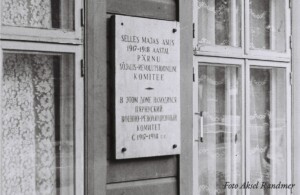
Between 1950 and 1989, Supeluse Street was named Nõukogude Street (“Soviet” Street), precisely because the Pärnu Military Revolutionary Committee was located here in 1917. A plaque was also unveiled on the wall to commemorate it.
Commemorative plaque on the wall of 12 Nõukogude Street in 1967
In 1920, Johannes Ruut, a stationmaster and timber merchant in Surju, bought the house from Bathelt’s heirs and traded in lumber, firewood, shingles and other timber. The rooms on the first floor of the building were rented by Jakob Naudi, the chief of Pärnu County state lands, for his office. The task of the chief of state lands in the independent Republic of Estonia was to carry out the land reform – taking over the assets of manors and distributing them to land recipients in Pärnu County.
The Hugo Kuusner court case
 Johannes Ruut, the owner of the house, died in 1927, and his will named his next of kin – his wife, mother and stepdaughter – as his heirs. The widowed Anna Ruut, however, was reluctant to share her inheritance with her mother-in-law and her stepdaughter, and wished to keep it all for herself. She involved lawyer Kuusner, who was appointed guardian of the inheritance by the city’s Orphans’ Court, in her schemes.
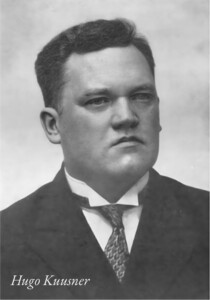
This was the second time that Hugo Kuusner (1887-1942) – a respected attorney-at-law in Pärnu, former mayor and member of the Provisional Assembly, the man who proclaimed the independence of the Republic of Estonia from the balcony of the Endla society house on the evening of 23 September 1918 – got into trouble with this house.
Anna Ruut and Kuusner were probably scheming together. The will provided for the immediate sale of the house in the event of the owner’s death and the proceeds to be divided between his wife, mother, and stepdaughter. However, under Anna’s pressure, Kuusner, as the administrator of the inheritance, took out a loan from Pärnu Krediitpank for the value of the house and also used it as collateral. The aim was for the house to be auctioned off at the bank’s request, the bank to get its money, and the heirs, other than Anna, to lose the money. The Orphans’ Court saw this as the acquisition of someone else’s property and initiated a criminal investigation with charges of fraud. Kuusner was found guilty of a professional offense and the Viljandi-Pärnu Magistrate’s Court sentenced him to one and a half years in prison.
Announcement in Pärnu Päevaleht newspaper 11 September 1929
Although the sentence was later commuted to two weeks of detention, Kuusner was expelled from the Bar Association and devoted the rest of his life to floriculture. He established a large flower garden with greenhouses and opened a flower shop in the centre of Pärnu and in the new Rannahotell. In 1941, his garden business was nationalised, Kuusner was deported to Siberia as part of the June deportations, and he died in Sevurallag, Sverdlovsk Oblast, on 23 March 1943.
Hugo Kuusner, Attorney-at-law
Cafés and society rooms
Before World War II, the owner of the house was Anton Varkel (1874-?), an infantry captain from Pöögle Parish, who studied at the Kazan Military School and took part in the Russo-Japanese War. He had retired from his position as the company commander of the Tallinn Guard Battalion and had been living in Pärnu for some time. He moved into a large apartment on the second floor, while the first floor was still rented out.
Practically every summer, a new café or diner operated here, and various Pärnu associations found suitable meeting rooms here. In 1937, the Pärnu Animal Protection Society, whose chairman was, by the way, the owner of the house himself, also had its premises here, as well as the Pärnu Russian Society, which until then had been located in Possieti Street. The society united the Russian community here, its leaders being Pärnu gynaecologist Dr Ivan Schanin and history teacher of the Boys’ Gymnasium Yevgeny Dampel.
Pärnu Russian Society’s acting group. Photo: Pärnu Museum
Nationalisation
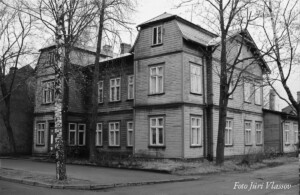 At the beginning of the Soviet occupation, the house was expropriated. After the war, the building was initially at the disposal of the military unit, and for a few years, the premises were occupied by the finance department of the Pärnu City Executive Committee. After that, however, the rooms were split into apartments with a communal kitchen. This way, the six-room apartment that was previously spread over the entire second floor was converted into four smaller apartments by adding partitions. Until the end of the 1950s, they mainly housed the families of officers of military unit 2175, while the first civilian Estonian families got into the house in 1960.
Supeluse 12 before renovation in 2008
Although these were small apartments, throughout the Soviet period, the rooms were rented out to Russian and Jewish families who came to Pärnu from Moscow or St Petersburg for the summer. For example, in the early 1960s, top violinist Igor Bezhrodny (1930-1967) and one of Russia’s most influential piano teachers Sergei Dorensky (1931-2020) rented a shared apartment in the house for the summer, together with their spouses.
After the restoration of independence, the apartments were privatised, and today there are 12 apartments in total. The courtyard house on Auli Street is also worth noting. The courtyard house, built in 1890 to house the janitor, was demolished, and a residential building was built in its place in 2016 (architect Peeter Pere), which, in terms of its size and finish, does not compete with the main house on Supeluse Street. Rather, it assumes the status of an outbuilding with dignity and fits well into the ensemble with the old warehouse in the same courtyard. Upon completion, it was considered one of the most outstanding new buildings in Pärnu.