 Happening today
 For travellers
 Business Pärnu
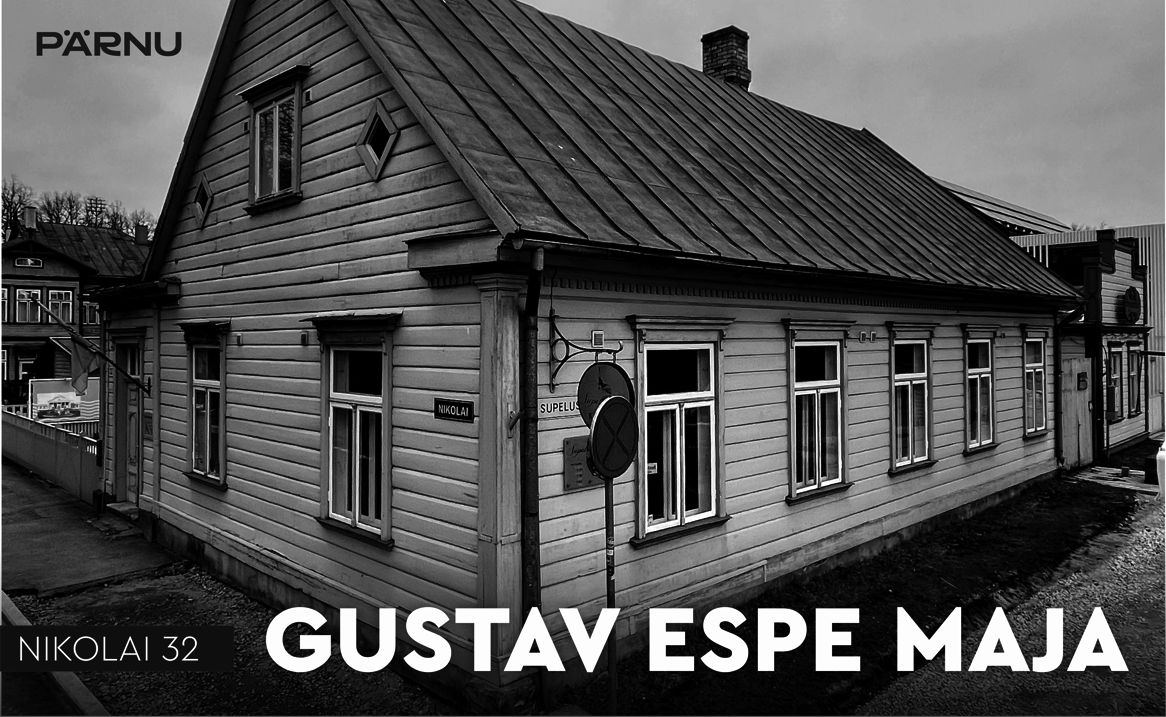
Also visit the café Supelsaksad located in the same building.
The dwelling on the corner of Nikolai and Supeluse streets was built by Franz Büttner in 1887. A courtyard house with a small apartment was also completed soon after. During the Soviet era, they were divided into separate properties and given different addresses.
 From the turn of the century, the house was owned by painter Gustav Espe (1864-1944), who moved from Rakvere to Pärnu, the hometown of his wife. In 1892, he married Pauline Luise Ratziborinsky (1866-1939), a girl from Pärnu. According to family legend, she was a descendant of a Pole who had remained in the Livonian Governorate since the Polish era. Pauline’s father was a full citizen of Pärnu, a barber named Cyprian Ratziborinsky (born 1824).
Gustav Espe became an active citizen of Pärnu, and a member of the city council for two terms. He was a member of the organising committee of the second Pärnu Song Festival in 1902, and also, for example, a member of the committee for the littering of Pärnu’s streets. In 1919, he helped organise the celebration of the first anniversary of the Republic of Estonia in the city, and was a member of the board of the Pärnu Houseowners Association. For his long service as a member of the Pärnu Volunteer Firefighting Association, he was elected an honorary member of the association in 1936.
Gustav Espe was a painter by trade, painting houses and making all kinds of advertising signs. “… walking along the rare footpaths of the rare parks of Pärnu, you take a turn into the city’s streets. And unexpectedly, you find the most popular name in Pärnu. G. Espe’s name appears on every, or almost every, sign, whether it’s made of tin, wood or whether it’s just an advertisement painted on the wall.” (excerpt from Tallinna Post, 12 July 1935)

He was also an amateur artist. Not much of his legacy has survived and therefore it has not been thoroughly studied. However, two of his works have been preserved by the descendants of relatives of Espe’s wife, Pauline.
In his work anniversary congratulations, Espe was described as a man of national awakening ideals, with a noble and national spirit.
Gustav Espe died in 1944.
 The heir to the property was Espe’s son Erich Adalbert Espe (1898-1960), a man who had studied in St Petersburg and at the Riga Polytechnic, and who had worked as the head of the Tallinn General Customs Office since 1928. A captain of an armoured train in the War of Independence, he escaped Soviet repression only because in 1941, he was forced to join the Red Army as part of the mobilisation of reserve officers. After the war, he lived in his parents’ house in Pärnu, of which he now had only a small apartment to use. When Erich Espe died in 1960, his heir, his sister Hilda, who had emigrated to the United States, sold the house as apartments to different owners.
Over the years, the apartments constantly changed owners. In March 1974, the plot was divided into two − the address of the house at the corner became 32 Võidu Street (now 32 Nikolai Street) and the dwelling built from the former courtyard house remained 5 Supeluse Street.
Cafe Supelsaksad
 In December 2009, a romantic café opened in the old wooden house, with a colourful yet nostalgic interior design (by Ruth and Anna Huimerind) that pays homage to the golden age of bathing culture during the Republic era. After its opening, the café was awarded the Estonian Association of Interior Architects’ Best Restaurant Interior Award and the “Silverspoon” award for the best café in Estonia in 2012.